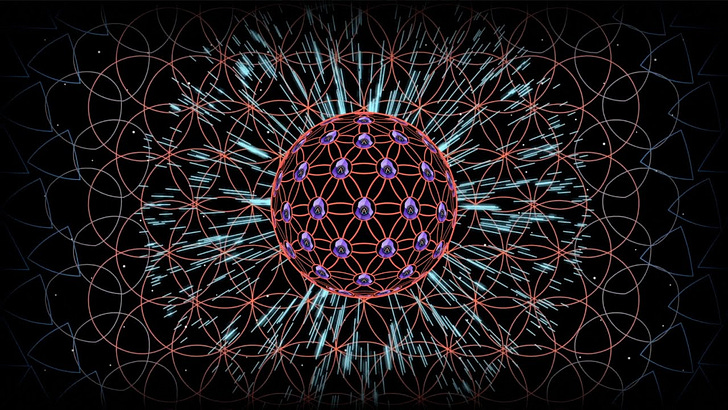

A conversation with David Rug about DreamWeaving, Project Liminality and building a Sovereign Open Source Collective Intelligence System.
When I first saw David Rug’s video The InterBrain — How Collective DreamWeaving Can Heal the World. I sent it to every wiznerd I know.
This was early last year (2025) when it was making the rounds like a proper wiznerdspell does: entrancing us with deceptively simple visuals, hypnotic Pink Floyd soundtrack, consciousness-expanding idea space... A highly recommended watch, on the biggest screen you can find with lights low and the volume up.
Ever since, I’ve been following (and supporting!) David’s progress at Project Liminality as he successfully crowd-funded and built-in-public the first version of his visionary system, the InterBrain.
I recently had the honor and pleasure of getting a peek inside the InterBrain, which might be one of the most philosophically ambitious and innovative pieces of software that I’ve seen.
What started as a walkthrough of his just-released beta version turned into a two-hour journey through distributed knowledge systems, digital sovereignty, and what it might look like to replace the bureaucratic metaphors of our digital lives with something far more alive...
We Don’t Have the Tools to Match How Ideas Evolve
Here’s a tension that anyone working in emergent tech and culture spaces knows well: the ideas that matter most — the ones that develop in off-the-cuff conversations, at non-stop in-person retreats, during late-night back-of-the-napkin sessions — are almost impossible to fully capture and share without their full context. You just had to be there. There was some special magic about the time, the place the people. The day after, it’s often hard to touch into that vibe again.
We do our best... take notes, record calls, dump mountains of data into shared documents and drives, run it all through our favorite AIs. But the living relationships between people, ideas and the stories that connect them? That’s what gets lost when it’s all summarized, filed away in digital drawers and archived into the clouds.
David came to this problem from the world of systems thinking and Game B, where he kept running into the same wall: brilliant people generating brilliant ideas with no infrastructure to weave them together. The tools we have — social media, shared docs, even platforms like Notion — are built on metaphors from the corporate world. Files. Folders. Feeds. They treat knowledge as static documents to be managed, not as living stories to be woven.
And thus was born the InterBrain, David’s elegant, evolving, deceptively simple answer to very complex as-yet-unsolved problem.
Enter the InterBrain
Right now, the InterBrain exists as a plugin for Obsidian that transforms your personal knowledge vault into a networked, peer-to-peer knowledge-weaving system. But this undersells it significantly.
It is in fact one of the most novel ontological paradigm shifts that I’ve encountered in terms of how we relate to ideas and each other in the digital etherspaces, building/growing/evolving our own unique and uniquely intertwined “liminal webs.” And this is just the beginning of the journey... And for right now, it’s a plugin that works in Obsidian, a popular personal knowledge management system.
Obsidian is the beta-stage chrysalis, incubating the InterBrain until it’s ready to emerge and take flight to the stars, creating its own independent constellation, the DreamOS (more on this later.) For now, Obsidian’s flexibility, with a whole suite of supporting layers that David’s cleverly woven together, has all the affordances needed.
As someone who uses Obsidian on a daily basis, I still felt like I was going through a portal when entering the InterBrain DreamSpace. The tools are familiar, but the topology feels different, and the ontology offers entirely new territories:
DreamNodes — sovereign containers for ideas, each one a [Git](https://git-scm.com/) repository that can hold media, text, evolving context, and nested sub-ideas.
DreamerNodes — representations of the people in your life, connected to the ideas you share with them.
DreamSongs — narrative threads that weave multiple DreamNodes together into coherent stories, displayed as constellations in a 3 D night-sky interface.
The poeticism is intentional. David is explicitly replacing the bureaucratic metaphors of the desktop (files, folders, documents) by shining a “shamanic” lens on the idea space. DreamNodes aren’t files, they’re egregores, “digital spirits” — living thought forms that propagate through conversations, contextualize themselves through symbols, evolve over time, form relationships with each other and weave humans together through co-created meme-tapestries and conceptual constellations.
Drag-and-Drop Constellations
The actual workflow is intuitive, especially given that the early stage of the system. When I enter the DreamSpace for the first time, I begin at the InterBrain — a central DreamNode that anchors the entire space.
This is the meta-center, and it’s beautifully self-referential: the InterBrain plugin on my machine contains is the first DreamNode in my vault and it contains all the source code within it — the seed from which all Liminal Webs grow and eventually intertwine, connecting me to everyone else running the InterBrain.
From this anchor point, I start building my Liminal Web. I drag in images, notes, memes and media to create DreamNodes — essentially multimedia thought-containers. Then I add Dreamer Nodes for fellow dreamers — friends and collaborators, linking DreamNodes to Dreamers, connecting the ideas that we share.
David’s recommendation here is: don’t put strangers into your InterBrain. This is your tribe. These are the people you trust, the ones whose signal you want to receive and amplify. The Liminal Web is intended to be intimate by design, and I appreciate the practice of weeding of my digital garden.
DreamSongs are where the weaving really happens. I can take any collection of DreamNodes — symbols, memes, ideas, media — and compose them into a narrative thread. I lay them out on a canvas, connect them together, and the InterBrain creates a linear flow, even if my connections are all over the map (see the video above for a clearer sense of the process.)
What’s beautiful about this is that it embraces chaos by design. I can throw everything onto my canvas, and unconnected ideas simply get ignored until I’m ready to weave them in. Structure emerges from play, not from pre-planning.
As I weave more DreamSongs, the magic really begins in constellation view. My DreamerNodes become stars in a 3D sky, and the DreamSongs that connect them form visible constellations. Over time, my entire knowledge landscape becomes navigable as a night sky of interconnected ideas and people.
If this sounds dreamy (and maybe a bit hazy) take a look at the video, as it’s easier to show than tell in the DreamSpace.
Sovereign by Design
Under the hood, the InterBrain is built entirely on open-source protocols — Git for data sovereignty and Radicle for decentralized peer-to-peer collaboration. Every DreamNode is a Git repository. Every collaborator maintains their own sovereign branch. There’s no central server, because DreamNodes are downloaded locally when they’re shared. There’s no forced consensus, no algorithm deciding what you see...
When someone in your Liminal Web makes a change to a shared DreamNode, you see it in your inbox and can preview, accept, or reject each commit individually. David calls this the Social Resonance Filter — if a brilliant artifact resonates, it propagates through the network like signal through mycelium. If it doesn’t, it simply doesn’t spread. The network self-organizes through trust, taste and resonance. Vibes as infrastructure FTW.
And when someone uses a shared DreamNode as part of a larger DreamSong you haven’t seen yet, the InterBrain sends a Coherence Beacon — an invitation to check out the bigger game. You receive not just the new story, but all the puzzle pieces it contains that you don’t already hold. Your horizon expands gently, through trust.
(For a deeper dive into the Git architecture, the Coherence Beacon mechanics, and how DreamNodes are becoming an AI agent framework, check out the companion post Deep Dive Inside The InterBrain.)
No Profiles: A Radical Design Choice
One of the most striking decisions in the InterBrain is the absence of user profiles. There is no “this is how everyone should see me.” Drawing on Douglas Harding’s observation that in the natural world you see faces everywhere but never your own, David chose not to include a self-representation in the system.
Instead, your entire vault is your subjective expression. The DreamerNodes you create of others are your unique perspective on them — you might use a funny photo from when you were kids, or custom avatar where they’re a wizard (again, check the video :) and add notes about inside-jokes, meaningful moments, anything that’s relevant between the two of you. The question is: how do I see this person?
This sidesteps the entire pathology of social media profiles — the self-censoring, the performance, the mask-building for an unknown audience. In the InterBrain, identity is relational, not performative.
Song Lines and the Spoken Words as Sources of Truth
One feature that particularly resonates with my work as a semi-obsessive documenter and copious note-taker is the InterBrain’s soon-to-be-released Co-Pilot Mode. Here’s what it does: during video calls, the system runs local transcription and uses semantic search to surface relevant DreamNodes in real time. Every time you invoke an idea, a meme, a DreamNode during a conversation, the system remembers when you invoked it and what was said — creating what David calls Song Lines.
Over time, each DreamNode accumulates a rich history of how it’s been explained, shared, and evolved through live conversation. This is profound, as the spoken word becomes the source of truth. You don’t have to write everything down perfectly, don’t even have to take notes, if you’re not a note-taker. You just talk, and the InterBrain captures how ideas propagate from person to person, each time slightly differently — building a multi-faceted understanding. (I suggested to David that this recorded history and lore of a DreamNode be named the SongBook.)
There are things that are hard or impossible to define in writing, but you can explain them, vibe them, feel them. If you have hundreds of recorded conversations touching on a concept — that’s the richest possible description. Like love: there are hundreds of ways of describing what it is, and the collection of songs is truer than any single definition.
From Content Creation to Context Creation
DreamNodes aren’t just content to be consumed — they’re contexts that can hold the evolution of ideas, nest recursively, and form relationships. An image is a DreamNode that can be nested in a DreamSong of related ideas that are themselves nested in a constellation of DreamSongs which might end up being the source material for a video, much like David’s first video opus on InterBrain linked above (again, watch it, you’ll thank me later.)
When it comes to context, one thing I love is that the Git foundation means everything carries its provenance. Ideas and memes propagate with memory of where they came from. Not cryptographic proof — just natural provenance, the way you’d remember who told you about something and pass that along when you share it with someone else. The cultural layer handles attribution through the conversations that are baked into every DreamNode’s Song Lines.
Ideas as Sovereign Beings
Maybe the most fascinating philosophical thread in our conversation was about the ownership of ideas. David’s position is striking: he wants to build infrastructure that encodes the notion that you don’t own ideas. Every DreamNode comes with a baked in open source “copy-left” license by default — you can do whatever you want with the idea, but you can’t close it off or monetize it without keeping it open source.
This isn’t enforced. Everything in the InterBrain is invitation-based. You can delete the license. But the cultural nudge is clear: ideas, like stories, are sovereign beings. They enter the world through people, but they don’t belong to anyone. The more freely they flow, the more alive they become.
As David put it: “The moment you’re like, ‘Oh, this is brilliant, how do I make a patent out of this?’ — that idea is like, ‘Uh-oh, be cautious, this guy wants to use us.’ So the idea goes somewhere else, where someone is just more of a channel.”
The Road Ahead: DreamOS and Keeping the Dream Alive
As noted above, David’s vision extends well beyond an Obsidian plugin. He’s building toward what he calls DreamOS — an agentic operating system that replaces the desktop metaphor entirely. Built on Arch Linux, it would turn the file explorer into a Dream Explorer, the desktop into a “scrying mirror” where digital spirits arrive when they’re summoned or needed. The entire ecosystem would be open source, co-created, and sovereign.
When I asked David what he needs to keep going, the answer was simple: support from crowdfunding. The initial campaign supported a year of full-time development starting in early 2024. That support is drying up as he’s been heads-down building. He needs a few hundred dollars more per month to sustain the work... So please support the InterBrain on Open Collective!
By Wiznerds, For Wiznerds
What struck me most about the InterBrain isn’t any single feature — it’s the coherence of the philosophy underneath. Every design choice traces back to a question: how does knowledge actually flow from source and between people? Not how do corporations manage documents, but how do stories move through us, through our minds, our collective consciousness? How do ideas resonate though networks and find the people that they need and who need them?
In a world where most collaboration tools assume hierarchies, the InterBrain is mycelial. Where most tools treat knowledge as static content to be organized, it treats ideas as living beings to be woven. Where most platforms demand you perform your identity, it lets identity emerge naturally through relationships.
It’s early. It’s rough around the edges. But the soul is sound, the philosophy is deep, and the foundation gives it a kind of structural integrity that more ambitious-sounding projects often lack.
This is exactly the kind of tool the Wiznerd Network exists to surface: technology built by and for the people trying to weave a different world into being.
I’m also sharing the full deep-dive conversation with David, where we go under the hood of the InterBrain’s architecture — the Git sovereignty model, how Coherence Beacons actually work, DreamNodes as an AI agent framework, and more. If this article sparked something, that conversation will fan the flames.
Want to learn more about the InterBrain? Check out Project Liminality on YouTube, support the work on Open Collective.
Have thoughts on knowledge weaving tools for regenerative communities? I’d love to hear them in the comments.
—-
About this post: This is based on a January 25, 2026 demo and conversation with David Rug. The InterBrain is in active development and features may have evolved since this writing.